How to Choose an Injection Molding Scrap Crusher for Recycling
Choosing an injection molding scrap crusher is not just about motor power or machine price. In an injection molding plant, sprues, runners, gates, trimming scraps, and rejected parts are generated every day. If these materials are not handled properly, they take up floor space and may affect downstream recycling, material blending, and reuse quality.
Before selecting a machine, it is important to understand the material type, scrap size, thickness, daily output, whether the scrap needs to be recycled immediately, and whether the plant is more suitable for beside-the-press granulation or centralized grinding. These factors directly affect the crusher model, blade design, feeding method, noise control, and the overall plastic recycling equipment setup.
Quick Summary: What Should You Check Before Choosing an Injection Molding Scrap Crusher?
When selecting an injection molding scrap crusher, start with these six key factors:
| Evaluation Item | Why It Matters |
|---|---|
| Material type | PP, PE, ABS, PC, PA, POM, and other plastics have different hardness and toughness. |
| Scrap form | Sprues, runners, gates, trims, and rejected parts vary in size and thickness. |
| Scrap generation point | This affects whether beside-the-press or centralized grinding is more suitable. |
| Final use of regrind | This influences particle size, screen hole size, and blending method. |
| Floor space and noise | Beside-the-press machines must fit the production layout and safety requirements. |
| Downstream recycling process | Conveying, dust collection, storage, mixing, or pelletizing may need to be integrated. |
If the scrap volume is small and the material is consistent, a beside-the-press granulator may be a good fit. If the plant handles multiple materials, larger volumes, or needs to manage regrind centrally, a centralized grinding system and a more complete plastic scrap recycling workflow should be considered.
Why Does Injection Molding Scrap Need to Be Handled Promptly?
Injection molding scrap needs proper handling because it is produced continuously and often has reuse value. Common sources include sprues, runners, gates, trial molding scrap, trimming scrap, and rejected molded parts. Without proper sorting and stable grinding, these materials can lead to storage issues, contamination, material mix-ups, and lower recycling efficiency.
For an injection molding plant, grinding sprues and runners is not simply about reducing material size. The goal is to prepare the regrind for the next step, whether that is blending, storage, reuse, or further recycling. If the ground material is too uneven, blending may become unstable. If different plastics are mixed together, product quality may be affected.
This is why injection molding scrap recycling should start with the production flow: where the scrap is generated, how often it is produced, whether it needs to be moved manually, whether it will be blended back with virgin material, and whether it should be stored centrally. The clearer the workflow, the easier it is to choose the right equipment.
When Is a Beside-the-Press Granulator Suitable for Injection Molding?
A beside-the-press granulator is suitable when the material source is consistent, scrap volume is stable, and the plant wants to process sprues, runners, gates, or small scraps directly beside the injection molding machine.
The main advantage is a shorter handling path. Scrap does not need to be moved to a separate grinding area, and in many cases, this helps reduce floor clutter and lowers the risk of mixing different materials. For single-material, single-color, or stable production runs, beside-the-press granulation can be a practical way to support immediate recycling.
However, beside-the-press granulation is not suitable for every plant. If the scrap is too large, too thick, or produced in high volume, the machine size, hopper design, feeding method, and operating safety must be reviewed carefully. A compact machine may be convenient, but it still has to match the actual load on the production floor.
Centralized Grinding Is Better for Higher-Volume Plastic Scrap Recycling
A centralized grinder is usually more suitable when a plant handles multiple scrap sources, higher material volume, or needs to manage regrind in one dedicated area. In this setup, scrap is collected from different machines and processed in a fixed grinding zone, then sorted or stored by material type, color, or reuse purpose.
For factories with multiple injection molding machines, centralized grinding often makes scrap management easier. It allows the plant to organize labor, dust collection, noise control, storage bins, conveying equipment, and downstream plastic recycling equipment in one controlled workflow.
The key to centralized grinding is material separation. Different plastics, colors, or contaminated materials should not be mixed simply for convenience. If the regrind will be reused in injection molding, material consistency is often more important than grinding capacity alone.
Beside-the-Press Granulation vs. Centralized Grinding: What Is the Difference?
The biggest difference between beside-the-press granulation and centralized grinding is where and how the scrap is handled. Beside-the-press granulation focuses on immediate processing near the molding machine. Centralized grinding focuses on controlled collection and management.
| Comparison Item | Beside-the-Press Granulation | Centralized Grinding |
|---|---|---|
| Best suited for | Single machine, consistent material, smaller scrap volume | Multiple machines, larger scrap volume, centralized recycling |
| Installation location | Next to the injection molding machine | Dedicated grinding area |
| Main advantages | Less handling, lower risk of material mix-up, immediate processing | Easier management, better integration with dust collection and conveying |
| Key considerations | Space, noise, safety, feeding convenience | Sorting, transport, storage, workflow connection |
| Typical equipment | Small or medium beside-the-press granulator | Medium to large heavy-duty grinder or recycling system |
If the plant processes a simple and consistent material stream and wants sprues and runners to return to production quickly, beside-the-press granulation is often easier to implement. If the plant has multiple production lines, mixed materials, or larger volumes, centralized grinding is usually easier to control.
Can Sprues, Runners, and Rejected Parts Be Ground Directly?
Sprues, runners, and some rejected parts can often be ground, but whether they are suitable for direct reuse depends on material condition and the intended next step. Clean, single-material scrap without metal inserts or foreign matter is usually easier to process into usable regrind.
If the material contains metal inserts, oil, labels, other materials, or mixed plastics, it should not be blended back directly with virgin resin. These materials may need sorting, cleaning, or separate handling to avoid quality problems.
Large or thick rejected parts may also be unsuitable for a small beside-the-press granulator. In this case, the feed opening, cutting chamber size, blade strength, and machine load should be reviewed. A centralized grinder or pre-size-reduction process may be more appropriate.
Do Not Choose a Machine Based Only on Motor Power
The performance of an injection molding scrap crusher cannot be judged by motor power alone. Motor power affects the machine's load capacity, but actual grinding performance also depends on material toughness, sprue thickness, blade design, screen size, and feeding consistency.
Blade design affects cutting stability and regrind quality. Harder or thicker sprues require a more stable cutting structure. Thin or lightweight scrap may require attention to feeding behavior, because some materials can bounce or move unpredictably inside the hopper. Screen hole size also affects final particle size. A smaller screen usually produces finer regrind, but it may also reduce throughput.
Instead of asking only "How many horsepower is this machine?" or "How many kilograms per hour can it process?", a better question is: for this material, this scrap size, and this recycling purpose, what blade design, screen size, and cutting chamber configuration are suitable?
Can Regrind from Injection Molding Scrap Be Mixed Back with Virgin Material?
Whether regrind can be mixed back with virgin material depends on the plastic type, product quality requirements, and the plant's molding process. Not every regrind stream is suitable for the same reuse ratio, and not every product is suitable for recycled content.
Clean, stable, same-material and same-color sprues or runners are usually easier to plan for reuse. However, if the material is contaminated, heat-degraded, mixed with other plastics, or used for products with strict appearance or strength requirements, the reuse method should be evaluated more carefully.
In practice, each factory needs to define how regrind will be used according to product requirements. Grinding is only the first step. The plant still needs to consider blending ratio, drying conditions, resin properties, and finished product quality. This is why plastic scrap recycling should be planned together with the production process, not treated as a standalone machine purchase.
What Information Should You Prepare Before Asking for Equipment Recommendations?
To evaluate the right injection molding scrap crusher, equipment suppliers need practical material and production information. The more complete the information, the easier it is to avoid choosing a machine that looks suitable on paper but does not work well on the production floor.
It is helpful to prepare the following details:
- Material type: PP, PE, ABS, PC, PA, POM, or other engineering plastics.
- Scrap form: sprues, runners, gates, trimming scrap, rejected parts, or mixed sources.
- Scrap size: maximum length, width, thickness, and approximate weight.
- Output volume: hourly or daily scrap generation.
- Final use of regrind: reuse in injection molding, blending, storage, or pelletizing.
- Plant layout: machine location, feeding method, noise limits, and conveying needs.
If material photos or samples are available, they can help the supplier evaluate the blade design, screen size, and machine model more accurately. For plants that handle multiple materials, it is also useful to separate the main material stream from occasional special materials, so the equipment selection is based on the real production priority.
Conclusion: Choose an Injection Molding Scrap Crusher Based on the Full Production Flow
Choosing an injection molding scrap crusher should not be based only on price, horsepower, or a single machine model. A better approach is to evaluate the material type, scrap form, output volume, regrind purpose, floor space, and downstream recycling process together.
For consistent materials and smaller scrap volumes that need immediate processing, a beside-the-press granulator may be suitable. For multiple injection molding machines, larger scrap volumes, or centralized sorting requirements, centralized grinding and integrated plastic recycling equipment may be the better direction. The right machine is not just the one that can grind the material. It is the one that fits the actual production flow and supports stable reuse.
Related Equipment Recommendations
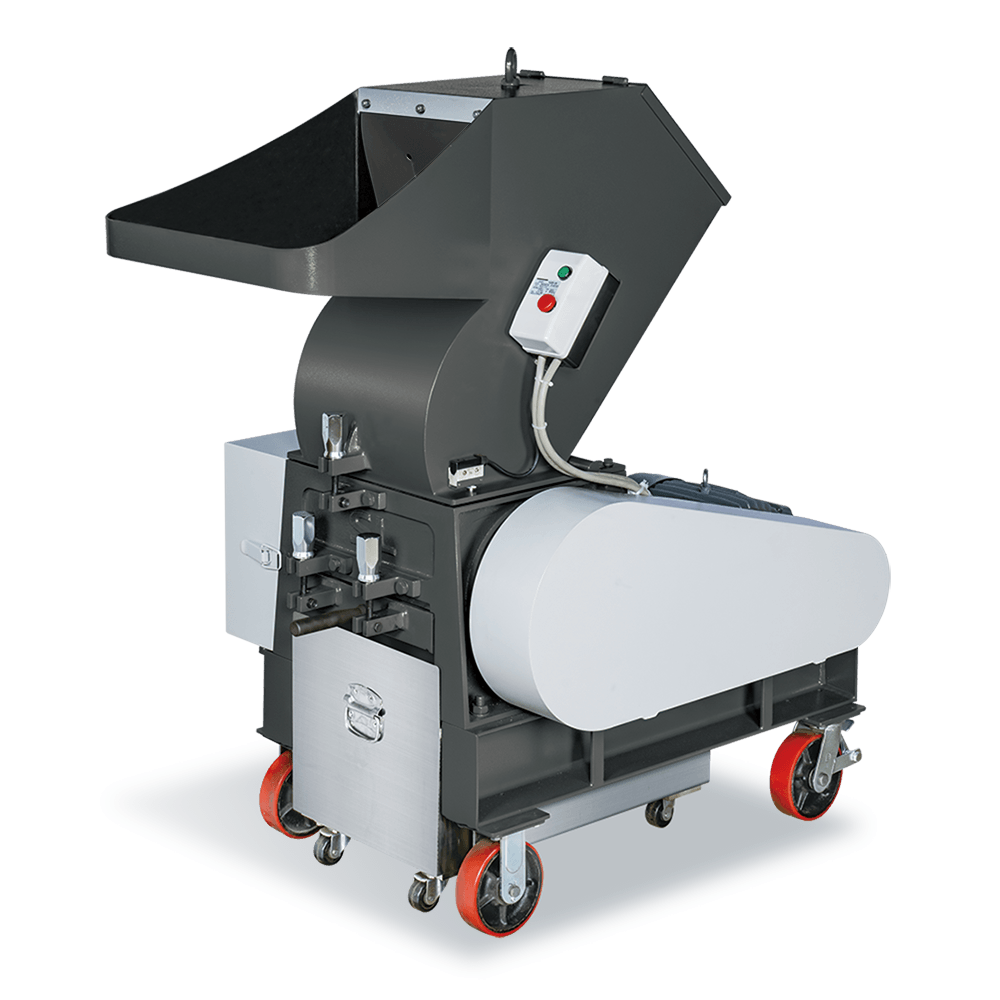
Injection molding scrap recycling does not always rely on a single machine. The right setup depends on material size, scrap volume, whether beside-the-press processing is required, and whether the regrind needs to connect with conveying, blending, or pelletizing processes. The following equipment can be used as an initial reference:
Need Help Evaluating the Right Injection Molding Scrap Recycling Equipment?
SHUEN LI provides plastic crushing, shredding, and related recycling equipment. Based on material properties, scrap size, and capacity requirements, we can help evaluate a suitable equipment configuration for your recycling process.
If you are looking for an injection molding scrap crusher, beside-the-press granulator, sprue and runner grinder, or a complete plastic recycling equipment setup, please share your material information and processing requirements. Our team can help assess the most suitable equipment solution for your application.
- Material type: such as PP, PE, ABS, PC, PA, POM, or engineering plastics
- Scrap size: including maximum length, width, thickness, and approximate weight
- Expected capacity: hourly or daily scrap generation
- Final use of regrind: reuse, blending, storage, conveying, or pelletizing